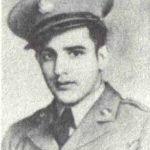
1st Lt. Roy Henry Mohr Jr. was born on March 1, 1920, in Forest Park, Illinois to Roy H. Mohr Sr. and Nellie K. Moran-Mohr, and was one of the couple’s four sons. His father was the Proviso Township Assessor. His family resided at 840 Thomas Avenue, Forest Park, he attended St. Bernadine School and was a member of the Proviso Township High School graduating class of 1937. After high school, he worked as a clerk at H. J. Mohr & Sons.
It appears that he may have been in the Army Reserves since he did not register for Selective Service when the act became law on October 16, 1940. It is known that he enlisted in the US Army Air Force on March 11, 1942, and since he had scored higher than 110 on the Army General Classification test, he was allowed to volunteer for the Army Air Corps and pilot training. He received additional training at Santa Ana Air Base, California, Stockton Field, California, King City Airfield, California, Hobbs Airfield, New Mexico, as a pilot for four engine planes. He qualified as a combat pilot and was commissioned a second lieutenant and given the Serial Number was O 733 696. He was assigned to 560th Bomb Squadron, HQ & HQ Squadron which was activated at Gowan Field, Idaho, in December 1942. From Gowen the squadron was moved to Wendover Field, Utah, in February 1943, where the unit was fully staffed and the squadron started its training with Boeing B-17 Flying Fortress heavy bombers. Training continued until June 1943, when it deployed to England. His B-17’s’s name was “Shack Up.”
Roy went overseas and was stationed at the Royal Air Force, Knettshall Station 136, England. During his time in England he flew 11 missions over occupied Europe. According to USAAF, his plane was part of a formation that left Knettshell at 5:47 am for a bombing mission on Stuttgart, Germany. One plane returned to the airfield because of mechanical problems and another apparently was shot down before the planes dropped their bombs. It was reported because of a heavy cloud cover the bombing was poor. The German fighter opposition was the heaviest they had experienced and fighters, three at a time, barrel-rolled through the formation. To the B-17 pilots it seemed that every time the German’s this maneuver, a plane was forced out of the formation, disabled, or destroyed. Once separated from the formation, the planes were attacked by hordes of German fighters.
Roy’s plane failed to return from a mission on September 6, 1943, so the USAAF, attempted to piece to together the events that caused the loss of Roy’s plane. According to the surviving crew members, the plane was hit by flack in it #2 engine, while over Stuttgart, and caught fire. The engine’s prop came off and hit the plane’s stabilizer damaging it. The plane’s right wing also had a huge hole in it from flack. Since the plane was having difficulty keeping up with the formation, it left the formation 35 miles from Stuttgart and was then attacked by German fighters.
Three of the crew members were rescued by the French Resistance and later returned to England March 1944. It was from these three men that information on the plane’s crash was collected. According to a member of the plane’s crew, Capt. Roland A. Marean, (promoted to captain after the event) he checked the rear of the plane and all the crew members were out of the plane. The plane’s tail gunner and waist gunner were wounded but bailed out with four other members of the crew. Before Marean bailed out of the plane, he checked on the Roy, the co-pilot and the plane’s engineer. They all had their parachutes on and were uninjured. Roy asked him to check to see if the plane was on fire. He did and told Roy the #2 engine was burning. Roy said to him, “OK. Jump!” We will be down, everything is under control.” After Marean jumped from the plane, he saw two other parachutes above his. The members of the crew landed in the vicinity of Malesherebes, Boulencourt, Coudray, France. Roy’s plane went down was reported to have gone down over Voves, France.
Another member of the crew, Capt. James G. Shilliday, (also promoted to captain after the crash) stated that he believed all the crew members escaped the plane. His statement was taken on July 10, 1944.
About the incident, Technical Sergeant H. H. Hasson said, “Three motors were out. No 2 threw its prop and caught on fire, I heard this from patriots later. It could have been any plane. But have no doubt that it did crash and it is impossible that it did not burn.” He also stated that he saw eight parachutes open. He believed that Lt. Elmer Schulz and Roy had a very good chance to get out of the plane.
Initially, Roy was reported Killed in Action on September 6, 1943, but on August 1, 1944, his status was changed to Missing in Action based on statements which were made by these men. As it turned out, four of the plane’s crew members, including Roy, were listed as Missing in Action. Post-war investigation shows two of the enlisted crew members and another officer were never recorded by the Germans as being Prisoners of War. The American Graves Registration Service concluded that the plane did not crash over France but continued to fly and went down in an unknown location. This decision was made even though all but one man were reported to have left the plane by crew members.
1st Lt. Roy H. Mohr Jr. was declared dead on August 10, 1945, and his date of death is recorded as September 6, 1943. A letter was sent to his father.
Mr. Roy H. Mohr, Sr.
840 Thomas Avenue
Forest Park, Illinois
Dear Mr. Mohr:
The records of the War Department show your son, First Lieutenant Roy H. Mohr, Jr., 0, 733, 696, air corps, missing in action over France since September 6, 1943.
All available information concerning your son has been carefully considered and under the provisions of Public Law 490, 77th Congress, as amended, an official determination has been made continuing him on the records of the War Department in a missing status. The law cited provides that pay and allowances are to be credited to the missing person’s account and payment of allotments to authorized allottees are to be continued during the absence of such persons in a missing status.
I fully appreciate your concern and deep interest. You will, without further request on your part, receive immediate notification of any change in your son’s status. I regret that the far-flung operations of the present war, the ebb and flow of the combat over the great distances in isolated areas, and the characteristics of our enemies impose on us the heavy burden of uncertainty with respect to the safety of our loved ones.
Very truly yours
(signed)
J. A. ULIO
Major General
The Adjutant General
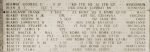
After the war, his name was placed on the Tablets of the Missing at Brittany American Cemetery, Saint-James, Normandy, France. Roy was one of two members of the 388th Bomb Group who remained missing in action after the war.