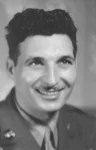
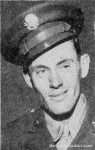
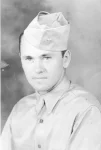
1st Lt. Walter Willard Ingalls was born in Iowa, on January 15, 1922, to Willard Ingalls and Alice Bell-Ingalls and had a sister. His father appears to have been a medical doctor. At some point, his family moved to 816 North 3rd Avenue, Maywood. Illinois, and he graduated from Westchester Grade School, Westchester, Illinois, Proviso Township High School, Maywood, Illinois, in 1938, and Iowa State College, in 1942, with a degree in engineering.
Since he did not register for Selective Service, he appears he enlisted on January 1, 1943, in the United States Army Air Corps in Iowa. It is known he was at Fort Sill, Oklahoma, on January 26, 1943, and at Pratt Airfield, Kansas from November 23, 1943 to December 31, 1943. Information on his training is skimpy, but it is known he trained at Salinas Airfield, California and Lowry Airfield, California. The order that he trained at these airfields in not known. He was commissioned a flight officer and received the serial number O 482 969.
He was sent to Asia and arrived at Chakulia Airfield, India, on April 2, 1944, and assigned to the 25th Bomb Squadron, 40th Bomb Group (Very Heavy), 58th Bomb Wing. With the unit, he flew a B-29-40-BW which had the Identification number: 42-24589 and had the name “Calamity Jane” The members of his crew were Capt. Aubrey J Richard, Pilot; 1st. Lt. William R. Fesler, Co-pilot; 1st Lt. Raymond C. Schuette, Navigator; 1st Lt. Jim E. Miller Bombardier; Walter was the Flight Engineer; 1st Lt. James L. Brennan; S/Sgt. Alvin K. Fiedler, Tail Gunner; S/Sgt. George W. Hanger, Central Fire Commander; S/Sgt. Herbert E. Bridges, Right Gunner; Sgt. Lee R. Chapman, Left Gunner; Sgt. Oliver M. Kidd, Radio Operator. In addition, there was a passenger on the plane, 1st Lt. Edward R. Walter.
On June 5, 1944, his crew flew its first mission to Bangkok, Thailand. It is known they flew bombing missions Mukden, Manchuria, Japan, and Singapore. On February 1, 1945, Walter’s plane took off on a mission to Singapore from Chakulia, India. In addition to the crew, there was a passenger 2nd Lt. Edward R. Walter, on the plane. Ingalls’ plane was part of a formation of 67 B-29s. Their mission was to bomb the Admiralty Floating Drydock. According to reports a four plane formation – a lead plane, a right wing plane, a left wing plane, and a trailing plane – approached the target. The Calamity Jane was the trailing plane. Three Japanese fighters each made one pass on the formation. In addition, flak was reported. It is believed that the run over the target occurred at 10 am.
After dropping their bombs, the planes headed northwest in the same formation. About five minutes into the flight a Japanese fighter attacked the four plane formation. It was reported that the fighter that was ahead of the formation and above the formation rolled over onto its back and dove downward through the formation firing the entire time. It is believed the Japanese pilot was trying to shoot down the lead bomber, but his bullets hit the right wing of the Calamity Jane. About 30 seconds after being hit, Capt. Richard’s, Calamity Jane’s pilot, made a slow turn to the right that put the plane on an east to east-southeast heading.
Another plane left formation and pulled alongside Calamity Jane. The two captains spoke on the radio, and Capt. Aubrey reported the right wing of his plane was on fire. The other pilot pulled up on the right wing but only saw fuel flowing from the wing creating a vapor trail. (Later reports stated the #3 engine was on fire). He could not locate a fire. (Other reports stated the #3 engine was on fire.) Capt. Aubrey stated he would take the Calamity Jane on a heading to the location of a US submarine that had the job of rescuing down crews. Both planes made slow turns to the east/southeast. When the second plane’s fuel supply became low, he pulled his plane out and headed back to the other two B-29s that were under attack by Japanese fighters.
About three minutes after the plane left, one of the gunners on the plane reported that he saw a Japanese fighter attack the Calamity Jane. He also reported that the Japanese fighter had been destroyed by a gunner on the plane. When Calamity Jane was last seen, it was flying at 18,000 feet and flying at a speed of somewhere between 180 to 195 miles per hour. The last message from the plane said that the Capt. Aubrey did not believe there was any immediate danger to his crew or plane. It is not known exactly what happened to Calamity Jane, but the other crews that had flown with the plane believed it was destroyed by enemy planes.
After the Calamity Jane did not return to the airfield, the plane was reported missing in action that same day, February 1, 1945. A telegram was sent to Walter’s parents.
MRS ALICE INGALLS
816 NORTH 3RD AVENUE
MAYWOOD ILLINOIS
THE SECRETARY OF WAR DESIRES ME TO EXPRESS HIS DEEP REGRET THAT YOUR SON SECOND LIEUTENANT WALTER W INGALLS HAS BEEN REPORTED MISSING IN ACTION SINCE TWO FEBRUARY IN SOUTHWEST PACIFIC PERIOD IF FURTHER DETAILS OR OTHER INFORMATION ARE RECEIVED YOU WILL BE PROMPTLY NOTIED PERIOD
ULIO
THE ADJUTANT GENERAL
The telegram was followed by a letter.
Mrs. Alice Ingalls
816 North 3rd Avenue
Maywood, Illinois
Dear Mrs. Ingalls:
This letter is to confirm my recent telegram in which you were regretfully informed that your son, Second Lieutenant Walter W. Ingalls, O-482, 969, Air Corps, has been reported missing in action since 2 February 1945 over the southwest Pacific.
I know that added distress is caused by failure to receive some information or details. Therefore, I wish to assure you that at any time additional information is received it will be transmitted to you without delay, and, if in the meantime no additional information is received, I will again communicate with you at the expiration of three months. Also, it is the policy of the Commanding General of the Army Air Forces upon receipt of the “Missing Air Crews Report” to convey to you any details that might be contained in that report.
The term “missing in action” is used only to indicate that the whereabouts or status of an individual is not immediately known. It is not intended to convey the impression that the case in closed. I wish to emphasize that every effort is exerted continuously to clear up the status of our personnel. Under war conditions this is a difficult task as you must readily realize. Experience has shown that many persons reported missing in action are subsequently reported prisoners of war, but as this information is furnished by countries with which we are at war, the War Department is helpless to expedite such reports. However, in order to relieve financial worry, Congress has enacted legislation which contains in force pay, allowances and allotments to dependents of the personnel being carried in a missing status.
Permit me to extend to you my heartfelt sympathy during this period of uncertainty.
Sincerely yours,
(signed)
J. A. ULIO
Major General
The Adjutant General.
A year later on February 2, 1946, the members of Walter’s crew were declared dead. A search was done to see if wreckage of the Calamity Jane could be found, but none was found. Guerrilla groups and others were contacted to see if any knowledge of a missing B-29 was known. On all occasions, nothing was learned about the plane or the members of its crew. Since 1st Lt. Walter W. Ingalls was missing in action, his name was placed on the Walls of the Missing at the American Military Cemetery outside of Manila, Philippine Islands.